Get Brighter Skin with glutathione face serum: The Complete Guide
April 23, 2026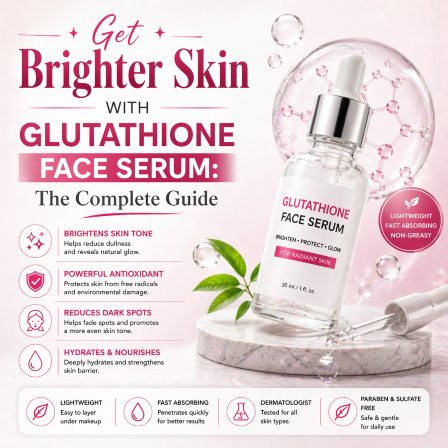
I honestly didn’t think a glutathione face serum would be the one thing that fixed my “why do I look exhausted after a full night’s sleep?” situation, but yeah, it happened. Last summer I stacked late nights, too much sun, and, not gonna lie, I didn’t reapply sunscreen like I should’ve, and my face went dull in that weird flat, gray-ish way that even a crisp concealer can’t really cover.
So I tested a handful of formulas, tracked everything like a total nerd, and figured out what actually changes your skin, and what’s pretty much pricey water in a fancy bottle. If you’re trying to decide if a glutathione serum is worth buying, which ingredients actually matter, and how to use it without wrecking your barrier, this is the guide I wish I’d had.
What a glutathione face serum actually does (and what it doesn’t)
Glutathione is one of those ingredients that gets hyped to the moon. People talk about “instant brightness” like you flip a switch and boom, glass skin. Real talk: it’s not like that. But it can help a lot if you’re chasing a more even tone and that healthy, awake-looking radiance.
Basically, glutathione is a strong antioxidant. On skin, the main idea is it can help reduce the look of discoloration by nudging pigment behavior in a calmer direction, while also helping defend against oxidative stress, think UV, pollution, and inflammation that hasn’t fully cooled off.
My contrarian take: glutathione isn’t the star unless the formula is smart
I believe most people miss this part, but the word “glutathione” on the label isn’t the whole story. A good glutathione face serum usually works because it’s built like a squad: glutathione plus stabilizers, penetration enhancers, and other brighteners that don’t fight each other (And this is important).
If the blend is flimsy, you’ll get, well, not much. Maybe some moisture. Maybe a quick glow from humectants. But real, lasting brightness? It probably won’t show up.
What it won’t do (so you don’t get disappointed)
It won’t erase deep melasma overnight. It won’t replace sunscreen. And it won’t fix texture problems like acne scarring all by itself.
Think of it as a steady “tone and glow” helper. Not a magic eraser. Makes sense?
How to choose a glutathione face serum that’s not a dud
I’ve paid for pretty packaging and regretted it. I’ve also bought into “clinical strength” claims that didn’t show any percentages, any testing notes, nothing, and I learned the hard way after wasting about $120 across two bottles that did basically zero. So here’s what I check now, and it hasn’t failed me yet.
Look for antioxidant “friends” that boost results
Glutathione tends to hit differently when it’s paired with other proven brighteners and antioxidants. I’m not saying you need a kitchen-sink cocktail, but a little synergy goes a long way, no cap.
- Vitamin C derivatives (gentler forms can be great if you’re sensitive)
- Niacinamide for uneven tone and barrier support
- Alpha arbutin for stubborn dark spots (when used consistently)
- Licorice root extract for a calmer, brighter look
- Hyaluronic acid or glycerin for hydration (glow loves water)
- Vitamin E to round out antioxidant protection
Ever wonder why some “brightening serums” seem to work faster? Usually it’s because a few of these are doing the heavy lifting next to glutathione, while the glutathione supports the whole antioxidant network.
Packaging matters more than people want to admit
Antioxidants can be fussy. If your serum shows up in a clear dropper bottle and you leave it in sunlight on a bathroom shelf, you’re basically speed-running oxidation, and the actives can degrade before you’re halfway through. I stick with opaque or amber packaging and, ideally, an airless pump, because it keeps the formula more stable and less exposed to oxygen. And yeah, I get it, droppers look fancy. But fancy doesn’t mean it’s gonna work.
Texture and irritation risk: don’t ignore your barrier
Some glutathione serums feel feather-light and soothing. Others are loaded with fragrance or alcohol and leave you tight, prickly, and annoyed. If your skin’s already reactive, go boring. Seriously, this changed everything for me.
My rule is simple: if it stings on day one, don’t “push through” for a week hoping
your face will toughen up. That isn’t resilience. That’s barrier damage, and once transepidermal water loss ramps up, you’re stuck playing catch-up.
How to use glutathione face serum for real results
Here’s where people lowkey sabotage themselves. They buy a decent serum, then stack it with five other activities like they’re building a skincare lasagna, and then they blame the glutathione when their skin freaks out. It works. Yeah, really.
My simple routine that actually worked
When I tested a glutathione face serum consistently, 8 weeks, same lighting for selfies, same cleanser, no random “just trying this mask” nights, the best results came from a boring routine. Not sexy. Just effective. While scrolling, the answer clicked, my skin didn’t need more steps, it needed fewer variables.
- Cleanse with something gentle (no squeaky-clean feeling).
- Apply serum on slightly damp skin (2 to 3 drops is plenty).
- Moisturize to seal it in.
- Sunscreen every morning, no exceptions.
That’s it. And yes, sunscreen is part of the brightening plan. If you skip it, you’re basically trying to fill a bucket with a hole in it, and you can’t out-serum UV.
AM or PM? I’ve done both
If your serum plays nice under sunscreen and makeup, morning use is great because antioxidants help deal with daily environmental stress, pollution, UV, and that general city-grime vibe. At night, it can also work, especially if you’re pairing it with barrier-repair ingredients like ceramides and cholesterol (Seriously, this changed everything).
Personally, I liked it best in the morning, mostly because it made me feel like I was preventing dullness instead of just reacting to it. But you can do either. Or both, if your skin tolerates it and you aren’t piling on irritation.
What to avoid mixing (at least at first)
Can you combine glutathione with acids or retinoids? Maybe. Should you do it on day one? I wouldn’t. Why risk it? If you’re using strong exfoliating acids (like glycolic) or a prescription retinoid, introduce your glutathione face serum on alternate days first. Then adjust. If you’re getting dryness, redness, or that weird shiny-tight look, back off, your stratum corneum is basically waving a white flag.
And here’s the thing: “more actives” doesn’t mean “more glow.” It often means “more inflammation,” and inflammation doesn’t make anyone look brighter.
Results timeline: what I saw, and what you can realistically expect
I get it, you want a deadline. Same. So here’s what I noticed across three different formulas I tested, with consistent use and daily SPF, and I didn’t change my cleanser or moisturizer mid-test because I couldn’t trust the data if I did.
Week 1 to 2: hydration glow (not true brightening yet)
Early on, the biggest shift was that my skin looked plumper and less flat. That’s usually hydration and reduced surface irritation, not pigment changes. Still, it’s motivating, and motivation counts when you’re trying to stay consistent.
Week 3 to 6: tone starts looking more even
This is where I saw the “radiant” part show up, especially around old post-acne marks. Not gone, but softened. My face looked more uniform in photos, which was kind of the whole point, tbh.
Week 8+: the compounding effect
With steady use, I noticed fewer “new” dark spots hanging around after breakouts. That surprised me, honestly. I could be wrong, but I suspect the combo of antioxidant support, calmer inflammation, and consistent sunscreen was doing the real heavy lifting, and then I realized...
FAQs (the questions people always ask me)
Is glutathione face serum good for hyperpigmentation?
It can be, especially for mild to moderate dark spots and uneven tone. For deeper melasma or hormonal pigmentation, you’ll probably need a more comprehensive plan, and sometimes a derm, annoying but true. Catch my drift?
Can I use glutathione face serum every day?
Most people can, yes. Start 3 to 4 times a week if you’re sensitive, then build up. If your skin gets itchy or tight, reduce frequency, don’t try to “power through” because you shouldn’t have to.
Does glutathione face serum work for acne-prone skin?
Often, yes, because antioxidants can help calm the look of inflammation. But watch the base formula. If it’s heavy, oily, or fragranced, it might trigger breakouts. Patch test. Always. I didn’t once, and I wasn’t happy about it.
Can I combine it with vitamin C?
Usually, yes, and it can be a great pairing. But if you’re using a strong, low-pH L-ascorbic acid and you’re prone to irritation, introduce slowly or use one in the morning and the other at night. Why make your face mad on purpose?
Is it safe during pregnancy?
This is one of those “ask your healthcare provider” moments. Topical antioxidants are often considered low risk, but formulas vary a lot, and I don’t want to pretend I know your medical context, I can’t, and I won’t.
Why isn’t my serum doing anything?
Common culprits: inconsistent use, no sunscreen, a weak formula, or expectations that are way too aggressive. Also, if your dullness is from dehydration, stress, or sleep debt, being there, skincare can only do so much. Think about it.
My final take: how to actually “unlock radiant skin” with glutathione
A glutathione face serum can be a legit glow-builder if you pick a well-formulated product, use it consistently, and protect your skin with daily SPF. Keep it simple, give it 6 to 8 weeks, and don’t sabotage your barrier chasing instant results. I've done that, I was wrong, and it wasn’t worth it.
I’m still testing different formulas and, honestly, I’m still learning. But if you want that calmer, brighter, more even look without turning your face into a chemistry experiment, this is one of the more reasonable paths I’ve found, and I’d argue it’s the only approach that didn’t leave me dry, irritated, and wondering what I did to deserve it.
Your Cart